
What do preschoolers learn? The areas public frameworks name
Published 2026-10-20 · Updated 2026-10-20
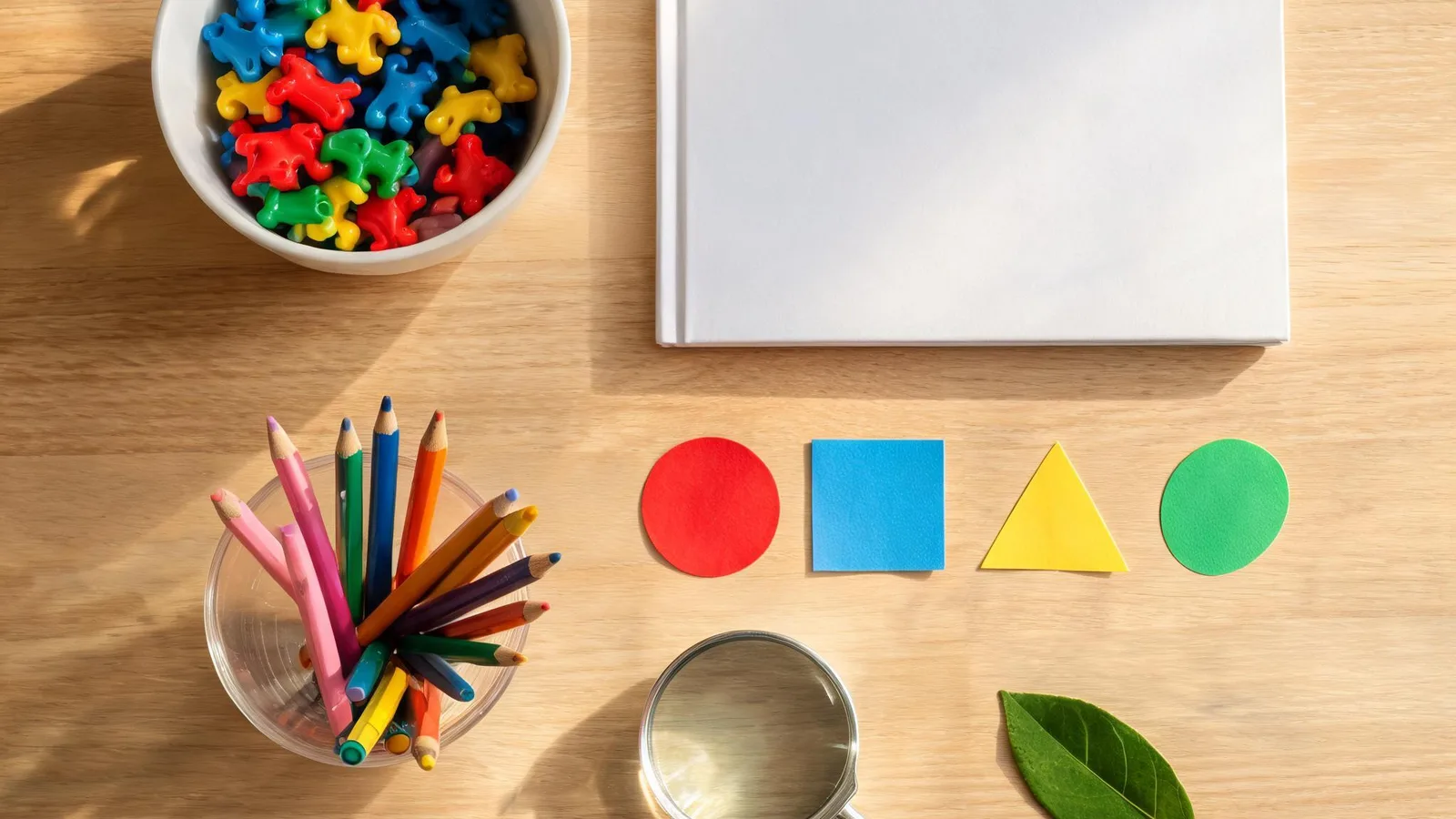
Preschoolers practice a handful of learning areas. They do not arrive with a hidden list of facts they must already know. For preschool age, the Head Start Early Learning Outcomes Framework (Office of Head Start, 2015, archived PDF) names these preschool domains:
- Approaches to Learning
- Social and Emotional Development
- Language and Communication
- Literacy
- Mathematics Development
- Scientific Reasoning
- Perceptual, Motor, and Physical Development
Those seven names are the subject list. The same file's central domains for birth to five are Approaches to Learning, Social and Emotional Development, Language and Literacy, Cognition, and Perceptual, Motor, and Physical Development. For preschoolers the contents list splits language into Language and Communication plus Literacy, and it lists Mathematics Development and Scientific Reasoning as their own preschool domains. Use the preschool names when you are planning for a three-, four-, or five-year-old at home.
The framework was written for programs. This article uses it as a map of what to practice together. It does not turn those goals into a result your child will reach, a school seat, or a score.
What each area can look like at the kitchen table
Approaches to Learning is the "how" of the morning: staying with a task, trying again, and choosing. At home that can be letting your child pick which book to open, or finishing one puzzle and stopping. You are practicing the habit of starting, not grading persistence.
Social and Emotional Development is feelings, helping, and getting along. A home version is naming your own feeling in a plain sentence, taking turns with a spoon and a cup, or comforting a stuffed animal the child says is sad. One child at home still has this area. A sibling, a grandparent, or a park trip is enough for "other people." You do not need a classroom for a turn-taking game.
Language and Communication is talk. Ask a real question about the day, wait, and answer in a full sentence. Tell a short story about breakfast. Point to what you mean when the word is new. The point of the activity is the conversation, not a tally of words.
Literacy is books, letters, and the idea that print carries a message. Read a library book you already have. Point to a letter on a sign or a cereal box. Sing a song you know by heart. Skip licensed shows and characters; a homemade song and a picture book are enough.
Mathematics Development is counting, comparing, shapes, and patterns. Count snacks as you set them out. Match two socks. Trace a circle on paper. Line up spoons from shortest to longest if your child likes lining things up. Stop when interest fades.
Scientific Reasoning is noticing and guessing. Ask what will happen if you drop a dry sponge in a cup of water, then look. Sort leaves on a walk by color or size. You are doing a small investigation, not running a lab.
Perceptual, Motor, and Physical Development is the body: big movement and hand work. Throw a soft ball, walk a line of tape on the floor, tear paper, or use a glue stick while you stay beside the scissors. An adult supervises scissors and small items. Keep small pieces away from mouths and from younger children: the American Academy of Pediatrics choking page says young children can choke easily on small objects they put in their mouths, and that many choking incidents happen when an older child gives a small object to a younger one.
NAEYC's planning statement uses a related map: domains of physical, social, emotional, linguistic, and cognitive development, and subject areas including language, literacy, mathematics, social studies, science, art, music, physical education, and health. Art and music are not separate preschool domain titles in the Head Start contents list, and they still belong in a home week: crayons, a drum made from a pot, a song. Social studies at home can be a talk about the people in your family and the places you walk. Health can be washing hands before a snack. NAEYC also says learning through play is a central part of curriculum, and that a written plan can be adapted to the child in front of you.
A four-year-old and a three-year-old can use the same areas with a different length. The younger sitting is shorter. The older sitting might add one more letter or one more count. Neither sitting is a test of what the child "should already know." Questions about what a two- or three-year-old should know educationally, or what a four-year-old should know academically before preschool or pre-K, are mixing two different papers. The framework names areas to foster. It is not an inventory of facts a child must bring on the first day.
Milestones are a different list
The CDC milestone page for four years says developmental milestones are things most children (75% or more) can do by a certain age. By four years, that page includes pretending to be someone else in play, asking to play with another child, saying sentences of four or more words, naming a few colors, drawing a person with three or more body parts, catching a large ball most of the time, and holding a crayon between fingers and thumb. Those are examples from a health checklist.
They are not the preschool syllabus, and they are not a pass mark for your week. A child can practice letters at the table and still be inside or outside that 75% line. If your child is not meeting one or more milestones, has lost skills he or she once had, or you have other concerns, the CDC page says not to wait: talk with your child's doctor, share your concerns, and ask about developmental screening. That is their instruction for health questions. It is not a reason to buy a harder workbook.
What the search results were doing instead
The first open result, a Brooklyn preschool overview from September 2, 2024, talks about what children may do inside that center's pre-kindergarten rooms. A center tour is useful if you are choosing a school. It is a weak stand-in for a subject list you can use on a Tuesday at home.
The second result, brightwheel's explanation of preschool program types, walks through models such as Montessori and Reggio Emilia. Program type answers "what kind of room is this?" The framework answers "what areas might we practice?" You can care about play and still want the area list. A later school page and a vendor skill wheel were also in the results. Quora stayed closed. The domain list above is the one to plan from.
What should you teach first, and what should you teach before a child goes to a preschool building? Start with talk, a book, and one hands-on bit from the list, repeated on another day. There is no single first lesson that unlocks the rest. If your child is already home with you all day, "before preschool" is the same map, done in shorter pieces. You are not cramming an entrance packet.
An illustrative afternoon of practice
This afternoon is illustrative. It shows a way to touch several areas once. It is not a forecast.
Read ten pages of a picture book and ask what might happen next. Count the cups while you set two places. Let your child choose the red crayon or the blue one, then color a circle. Walk to the mailbox and name one thing you both see. If scissors come out, you cut or you watch every cut. Stop while the mood is still friendly. Mark what you did so you can pick a different area tomorrow. Missing an area today is normal. The map is for the month, not for one hour.
If you want week files already sequenced
You can build the week from library books and household items, using the list above. If you would rather open a file that already sequences five days, Home Preschool Year: Preschool, ages 3 to 5 is a print-only PDF whose purpose is to show what to do with a three- to five-year-old each week at home: one week guide, what to print, what to gather, and pages to do together. It includes a Start Here guide, a Year Map of all 36 weeks, 36 week files, and Progress Checklists for letters, numbers, shapes, colors and early skills. Delivery is an instant download after checkout, and nothing is shipped. The progress checklists are your own mark of practice, not a test and not a school-readiness result.
Buying nothing still leaves you the domain list, the CDC caveat, and the afternoon sketch.
Next reads: what a home pre-k curriculum decision looks like, free preschool curriculum if you want a no-charge starting file, a preschool homeschool schedule if the question is when in the day to put these areas, and activities for four-year-olds if you want a single game rather than a domain name.
What subjects do preschoolers learn?
Public frameworks name approaches to learning, social and emotional life, language, literacy, mathematics, scientific reasoning, and movement. Art, music, and people-and-places talk sit inside those areas at home.
What is a typical preschool curriculum?
A typical written plan touches those areas across the week through play, talk, books, and short hands-on tasks. It is a plan for what you do, not a list of facts a child must already know.
What does preschool curriculum consist of?
It consists of the experiences you offer on purpose: stories, counting, movement, making, and time with other people, written down so the week is not only whatever is left at bedtime.
What is normally taught in preschool?
Centers and homes usually practice letters and sounds, numbers and shapes, talk, play with others, and moving the body. The mix and the pace are chosen by the adult, not fixed by one national script for home.
What do kids learn in pre-kindergarten?
Pre-kindergarten uses the same preschool areas, often with a bit more letter and number practice than a younger three-year-old's week. The areas are still practice, not an entrance exam.
What is a curriculum in early childhood?
It is the written plan for learning experiences. NAEYC says that plan should be adaptable and should cover the main areas, with play in the middle of it.