
Activities for 4 year olds at home, with adult notes
Published 2026-10-16 · Updated 2026-10-16
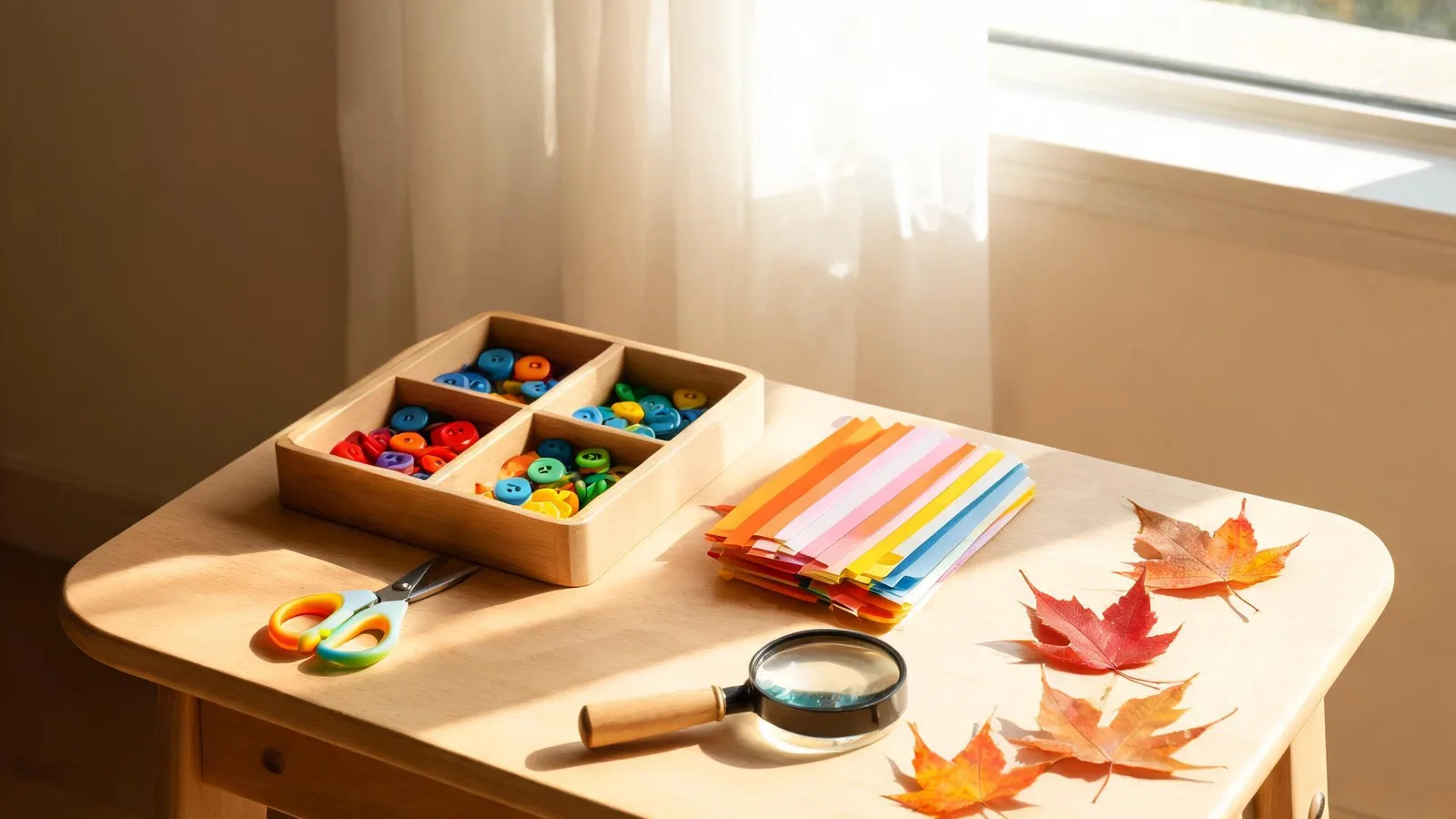
Activities for 4 year olds at home can keep a child busy without a classroom. Do these jobs together, flag the ones that need you in the room, and turn the rest into a simple week. This is a menu of things to do, not a promise about what a child will be able to show.
Start here:
- Sort and count socks, spoons, or leaves.
- Draw and "write" on a notepad, including a pretend menu or a sign for a shop.
- Build a grocery, a bus, or a restaurant from empty boxes.
- Play red light, green light or freeze dance in the hall.
- Read one book and ask what happens next.
- Help with one real chore: wipe a table, feed a pet, or bring in the mail.
- Walk outside and talk about over, under, big, and bigger.
- Play tag or follow the leader when you have space, or hide and seek in two rooms.
Penn State Extension lists reading every day, nursery rhymes, paper for writing, sorting and counting, position words, and extra boxes for pretend play as things to do with four-year-olds. CDC's four-year tips add counting fingers or bananas, asking colors and shapes of things you see, and outdoor games such as tag, follow the leader, and hide and seek.
Jobs to do with a four-year-old this week
A four-year-old can often carry a slightly longer job than a three-year-old, and they like to talk while they do it. Penn State Extension describes four-year-olds as talkers who ask who, what, when, where, and why, and who may mix up what is real and what is pretend. Expect tall tales during the shop game. You do not have to correct every one.
How to entertain a four-year-old at home on a closed-in day:
- One talking job. Sort laundry and name colors, or read and ask what might happen next. CDC uses that story question as a reading prompt.
- One moving job. Freeze dance, red light green light, or a pillow path. CDC suggests red light, green light and freeze dance when a child is excited and needs a stop-and-wait game.
- One pretend job. Empty food boxes, a notepad, and you as the customer. Position words fit here: the apple is under the box, the bag is on the chair. Penn State Extension suggests talking about in, over, under, big, bigger, and biggest while you play.
- One helping job, then stop. CDC names bringing in the mail, feeding a pet, or wiping tables.
HealthyChildren.org says preschool-age children need at least 3 hours of physical activity every day, or about 15 minutes every hour they are awake. You do not have to schedule a workout. Tag, a walk, freeze dance, and hallway races are the activity. Spread them through the day rather than saving them for one tired burst.
If the child is still closer to three, shorter pour-and-match jobs are on the three-year-old activity page. A mixed-age morning that is not split by age is on preschool activities at home.
Which tasks need you beside them
| Job | You stay? | What the child does |
|---|---|---|
| Sock sort | Nearby, can fold in the same room | Matches pairs and counts |
| Notepad writing | Nearby | Scribbles, draws a sign, or copies a name if they want |
| Empty-box shop | Nearby | Pretends, talks, changes the rules |
| Freeze dance | In the room, you run the music | Stops and goes |
| Red light, green light | In the hall with them | Moves and stops on your word |
| Scissors or beads | You supervise closely | Cuts paper or strings only large pieces you hand them |
| Outdoor climb or a fast tag game | Eyes on them | Runs, and may try a jump they cannot land |
| Bath or sink water | You stay with the pour | Pours with cups |
Penn State Extension says to keep supervising closely because a four-year-old may overestimate what they can do and try a risky trick. That close supervision is the adult role on the scissors-or-beads row, and on climbing or a fast game near a street, not a reason to cancel the walk. For the bath-or-sink row, you stay with the pour: CDC drowning prevention says to supervise closely and constantly when children are in or near water, including bathtubs.
Parts that fit entirely in the small-parts cylinder are a choking hazard on toys meant for children younger than three, and the CPSC small-parts guidance is the rule makers follow. A four-year-old is past that product age. You still supervise closely, as Penn State Extension says to do, and you hand them large pieces rather than tiny ones.
Preschool-style play you can copy at home
People ask what a four-year-old should be doing, including at preschool. Use that question as "what can we do," not "what must they already do."
A preschool-style block you can copy after breakfast:
- Song or fingerplay, two minutes of your voice.
- One book, with the "what happens next" question from CDC.
- Hands: scrap-paper collage, playdough, or blocks. HealthyChildren.org suggests crayons, paper, glue, and old magazines for a collage, and letting the child pick a few scraps with eyes closed if you want a surprise mix.
- Pretend with the boxes.
- Movement before you sit down again.
CDC also names matching games and tic-tac-toe. Play tic-tac-toe on the back of a flyer. If they would rather draw on the grid, the drawing is the activity. Rule games with a one-line rule are collected on games for preschool.
Penn State Extension notes that a four-year-old may change the rules of a game as they go. Let the shop have new prices. You are not refereeing a tournament.
Staying with one activity for ten to fifteen minutes is something that page lists among things many four-year-olds do. Use it as a planning hint for how long to protect the table, not as a score. If they leave sooner, the job is over.
A five-morning rhythm (illustrative)
This rhythm is an illustration. Skip a morning. Swap days. It is not a report card.
Monday: sock sort, one book, hallway freeze dance. Tuesday: empty-box shop and a walk with over and under. Wednesday: collage with scrap paper, you nearby if scissors come out, then tag in the yard or a pillow path if you stay in. Thursday: mail or table-wipe as the helper job, then tic-tac-toe or matching cards. Friday: repeat the shop if they ask, and add a new empty box.
A weekly rhythm is only a plan. A morning that ends after the song still counts as time together.
When you want the week written down, Home Preschool Year: Preschool, ages 3 to 5 gives you a Start Here guide and 36 week files, each with Day 1 to Day 5 steps, an easier option each day, a print-and-gather list, and activity pages. It is a print-only download; nothing is shipped. Look at a sample week file if you want to see the shape before you buy. The jobs on this page do not depend on that file.
Entertaining a long afternoon
Pick the row that needs you, do that one while you are free, and leave a child-led job (notepad, boxes, or socks) for the stretch when you are cooking. Offer two choices, which matches the CDC suggestion to limit choices to two or three. Then stop adding. More ideas are on the three-year-old page if the four-year-old job was too long, and on art and craft activities if the collage is the part they want again.
What are some fun activities for 4-year-olds?
Sorting real objects, a pretend shop made from empty boxes, a hallway game of red light green light, and a book you talk about.
How to entertain a 4 year old at home?
Give one job they can lead and one job you stay for. Switch when they wander, instead of adding a new craft.
What activities should a 4 year old be doing?
Treat this as a menu of things to do together, not a list of skills they must show. Counting socks, hearing a story, and moving their body are the usual jobs.
What are some fun preschool activities for 4-year-olds?
A short song, a picture book, a hands job, pretend play, and a run or a dance. That is the preschool shape, done in a kitchen.
What are some fun activities for a 4-year-old at preschool?
Preschool rooms often mix stories, block or pretend play, art with scrap paper, and outdoor games such as tag. You can copy one of those at home after pickup.