
Preschool activities at home today with things you already have
Published 2026-10-16 · Updated 2026-10-16
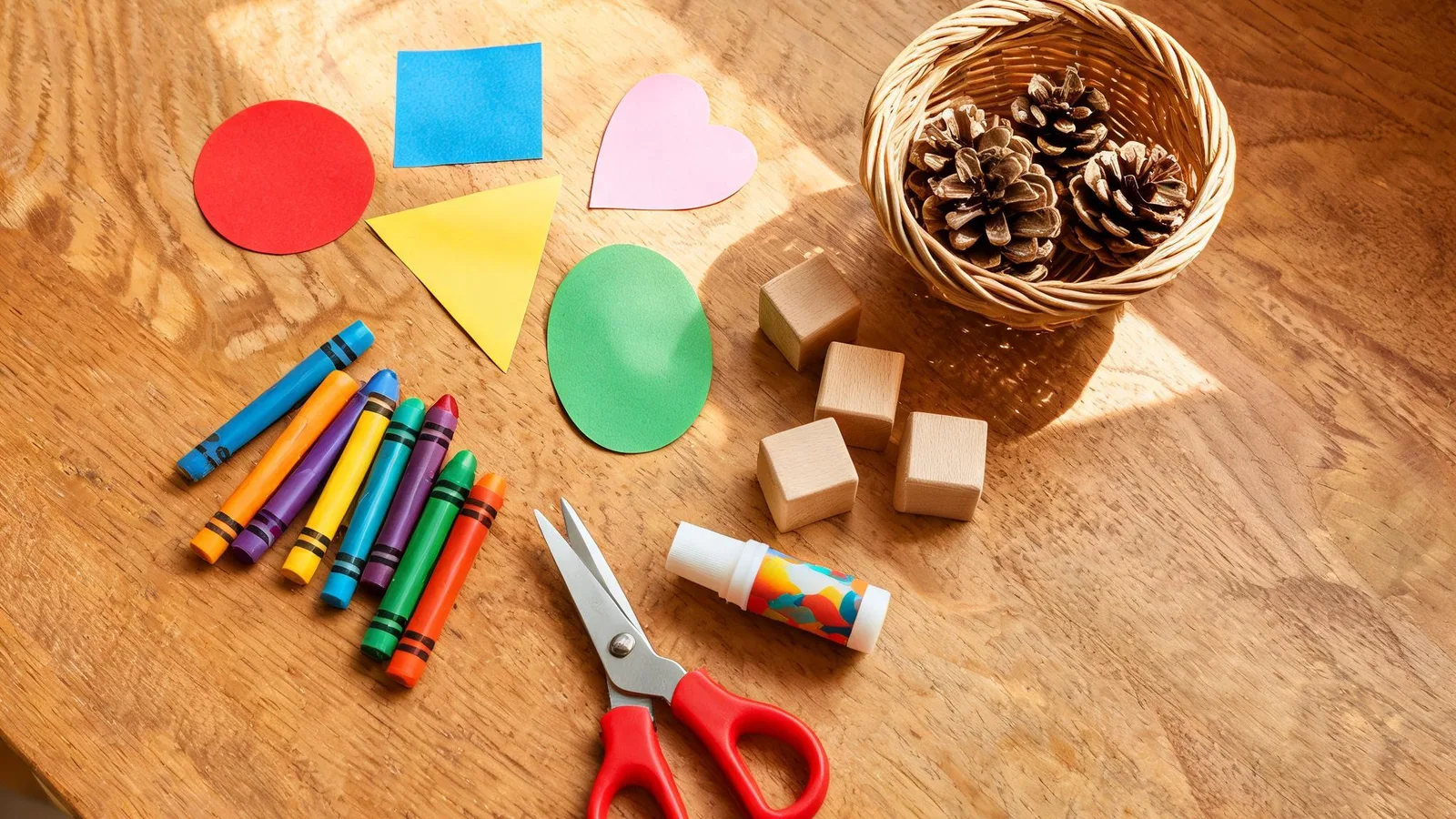
You can fill today with preschool activities that use what is already in the house. Here are ten to start with, then a way to sort them by time and by the kind of play.
- Sock sort. Gather a handful of clean socks. You name a color or a size, and your child hunts the match.
- Sink pour. Gather plastic cups already in the cupboard. Fill the sink a little and let them pour, dump, and refill.
- Pillow path. Gather couch pillows. Lay a stepping line from the sofa to the hall and walk it together.
- Box house. Gather one cardboard box. Cut a door only if you are holding the scissors, then play shop or bus inside.
- Cracker count. Gather the snack you were going to serve anyway. Count pieces onto a plate, one by one.
- Block walk. Gather shoes and a bag. On the sidewalk, play I-spy with a color, then a shape.
- Blanket-and-book corner. Gather a blanket and two picture books. Read one page, then ask what is happening in the picture.
- Spoon carry. Gather a spoon and a cotton ball or a dry bean. Walk to the table without dropping it.
- Laundry-basket toss. Gather a basket and balled socks. Toss into the basket from a short line you mark with tape.
- Crayon letter hunt. Gather paper and one crayon. Draw a letter, then walk the room and find one object that starts with that sound.
That list answers the "what can we do today" question before you shop or print anything. The rest of this page shows how to pick among them when the morning is short, how preschool rooms often mix the same kinds of play, and when a printed card is worth the ink.
Ten household preschool activities for today
Each job above has a gather line so you are not walking around the house inventing supplies. If you only have five spare minutes, pick sock sort, cracker count, or spoon carry. If you have a longer stretch before lunch, pick sink pour, the box, or the blanket corner.
The American Academy of Pediatrics describes screen-free play that needs almost no gear: Simon Says, Follow the Leader, a nature walk, and tag. With one child at home, you are the other player. In Simon Says, you give an action and your child copies it only when you say the cue words. In Follow the Leader, you move and they copy. On a walk around the block, name clouds, wet grass, or a bug instead of turning it into a quiz.
CDC's tips for a four-year-old include counting fingers, toys, or bananas, asking the color and shape of things you see, and playing tag, follow the leader, and hide and seek. Hide and seek in an apartment can be "hide the shoe": you hide one shoe, give a direction word such as under or behind, and your child finds it. Red light, green light works in a hallway. You say the color, they stop or go.
NAEYC's notes on play point to setups you can build from the kitchen: a pretend grocery with empty food boxes, blocks to stack and balance, and a menu your child draws for a pretend restaurant. None of those need a theme kit.
Sort them by how long they take
| Job | Gather | Time band | How you start |
|---|---|---|---|
| Sock sort | Clean socks | Short | "Find the other blue one." |
| Cracker count | Snack pieces | Short | "Put one on the plate each time we count." |
| Spoon carry | Spoon and a cotton ball | Short | "Walk to the chair. If it drops, we start again." |
| Laundry-basket toss | Basket and socks | Short | "Stand on the tape. Toss." |
| Pillow path | Couch pillows | Middle | "Step only on pillows." |
| Crayon letter hunt | Paper and a crayon | Middle | "This letter says /m/. Find something that starts that way." |
| Block walk | Shoes | Middle | "I spy something yellow." |
| Sink pour | Cups | Longer | "Fill, pour, dump." You stay for the pour, because CDC drowning prevention says to supervise closely and constantly when children are in or near water, including bathtubs. |
| Box house | A cardboard box | Longer | "Are we a shop or a bus?" |
| Blanket-and-book corner | Blanket and books | Longer | Read, then ask what is happening in the picture. |
Short jobs are the ones you can finish while pasta water heats. Longer jobs need you in the room the whole time. If your child leaves after one sock, that round is finished. A list is a menu, not a contract for the whole afternoon.
Sort them by the kind of play
Preschool activities fall into a few kinds of play. Sorting them this way helps when you already did a toss game yesterday and want a different feel today.
Matching and counting. Sock sort, cracker count, and a homemade memory game (two pairs of cards or two pairs of socks, face down). CDC also names matching games and tic-tac-toe as simple games to play together. Tic-tac-toe on paper is three marks in a row; you can play with a crayon and stop when they would rather scribble.
Moving. Pillow path, laundry-basket toss, spoon carry, tag, and red light, green light. These are the jobs for a wiggly body. Freeze dance is the indoor cousin: play a song, stop the music, everyone holds still.
Pretend. Box house, empty-box grocery, pots and pans as a restaurant. CDC suggests dress-up clothes, pots and pans, or blocks, and joining the pretend rather than directing it. Ask to be the customer. Let them set the price in scribbles.
Words and pictures. Blanket reading, letter hunt, and a notepad in the pretend shop. While you read, ask what is happening and what might happen next, which is the reading prompt on the CDC four-year page. You are not scoring the answer. You are talking about the picture.
Helping. Wiping the table, feeding a pet, bringing in the mail. CDC lists those as simple chores a child can join. One job, then stop. A long chore list turns play into nagging.
If your child is closer to three than to five, shorter matching and pouring usually fit better than a long rule game. The page on activities for 3 year olds stays indoors and keeps the setup smaller. If they want a longer job and a weekly shape, see activities for 4 year olds.
Creative play with scraps
Creative preschool activities do not start with a craft-store list. They start with something you were going to recycle.
- Junk-mail collage. Tear pictures from a grocery flyer (you tear, or they tear with their hands). Glue stick if you have one; a dab of flour-and-water paste if you do not.
- Box city. Two boxes become a garage and a house. Cars can be socks.
- Menu drawing. One sheet, a crayon, and you as the waiter. This is the pretend-restaurant setup NAEYC describes, done with paper you already own.
- Tape road. Painter's tape or masking tape on the floor. Drive a toy car, or a bottle cap, along the road. Pull the tape up when you are done.
Process matters more than a cute result. If the collage is a brown smear, it still counted as the creative job for today. More paper-and-scissors ideas sit on the art and craft activities page.
What preschool often looks like, copied at the kitchen table
People ask what pre-school activities are, and what kids actually do in preschool. In a home kitchen you can copy the shape without copying a classroom.
A common stretch looks like this: one song or fingerplay, one story, one hands job, one pretend scene, and one chance to move. You do not need all five before lunch. Two is a full home block.
Common activities in that mix:
- A song with motions, such as a spider rhyme or a star rhyme, while you sit on the floor.
- A picture book, with you asking what is happening.
- A hands job: playdough if you have it, or tearing paper, or placing cotton balls on a drawn circle.
- Pretend: shop, bus, baby dolls, or animals.
- Outdoor or hallway movement: tag, a walk, or follow the leader.
That is also the answer to "what are some ideas for activities for preschoolers" and "what are some fun preschool activities." Fun, here, means your child stays with it for a bit and you are not performing. If they want a game with a winner and a rule, switch to games for preschoolers and keep the same household supplies.
How to keep preschoolers entertained on a long indoor day: do not add a new theme every hour. Repeat one short job they liked, then change only the material. Sock sort can become mitten sort. Sink pour can become cup pour at the bathtub at the usual bath time. Repetition is not a failure of imagination.
Printable pages you can make with a pencil
Printable preschool activities are useful when you want the same page again tomorrow. You can make the first version by hand.
- Matching sheet. Draw six boxes. Draw each of three simple shapes twice, so all six boxes are filled and each shape has a twin. Your child points to the matching shape, or places a matching scrap of paper on it.
- Color hunt card. Write or draw four colors. Walk the room and touch one object for each.
- Count row. Draw circles. Your child places one cracker or one button on each circle, then you put the food back in the snack bowl. Buttons go away when you are done.
Loose pieces that fit entirely inside the small-parts cylinder are a choking hazard on products meant for children younger than three, which the CPSC small-parts guidance explains. You stay in the room while those pieces are out, because the CPSC toy safety publication says proper supervision of children at play is how to protect children from toy-related injuries.
When you want the cards already drawn, the Hands-On Kit Set: all 4 kits includes print-only PDFs for letter matching, counting cards, roll-and-move boards, and shape cards that you print and cut. Small pieces in that set mean an adult supervises play. A reader who never buys the set still has the ten household jobs above.
One afternoon using the list (illustrative)
This afternoon is an example, not a plan you must finish.
After breakfast, sock sort while you start laundry. Mid-morning, pillow path and then one book in the blanket corner. Before lunch, cracker count as the snack itself. Quiet time is the box with two stuffed animals, and you sit nearby with a drink. If the box lasts four minutes, you stop. The honest limit of this advice: a menu of ideas does not keep every child busy for a set stretch, and quitting early is allowed.
When the list runs out
Pick one kind of play you have not used yet, gather only what that row names, and start with one sentence of directions. If the job is a sink pour, you stay with the water, as CDC drowning prevention asks an adult to supervise closely and constantly whenever children are near water, bathtubs included. If it is a song or a sort, you can fold laundry in the same room. Tomorrow, repeat the one they asked for again, and add a single new material.
What are some easy activities I can do with my preschooler at home?
Use what is already out: sort socks, pour water in the sink, count snack pieces, or hide a shoe and hunt for it. Each one starts with a sentence of directions.
How to keep preschoolers entertained?
Rotate short jobs instead of hunting for one long project. When interest fades, switch the materials, not the whole room.
What are some creative activities for preschoolers?
A cardboard box, junk-mail scraps, and a crayon are enough for a house, a collage, or a pretend menu.
What activities do kids do in preschool?
A typical preschool stretch mixes a song, a story, a hands job, pretend play, and a run outside. You can copy that shape at the kitchen table.
What are some printable activities for preschoolers?
Draw a matching grid or a color hunt on paper you already have. Printed cards help only after the household version is clear.
What are 10 fun activities I can do at home?
The opening list names ten household jobs, from sock sorting to a laundry-basket toss, with what to gather for each.