
Games for preschool you can play with one child and no screen
Published 2026-10-16 · Updated 2026-10-16
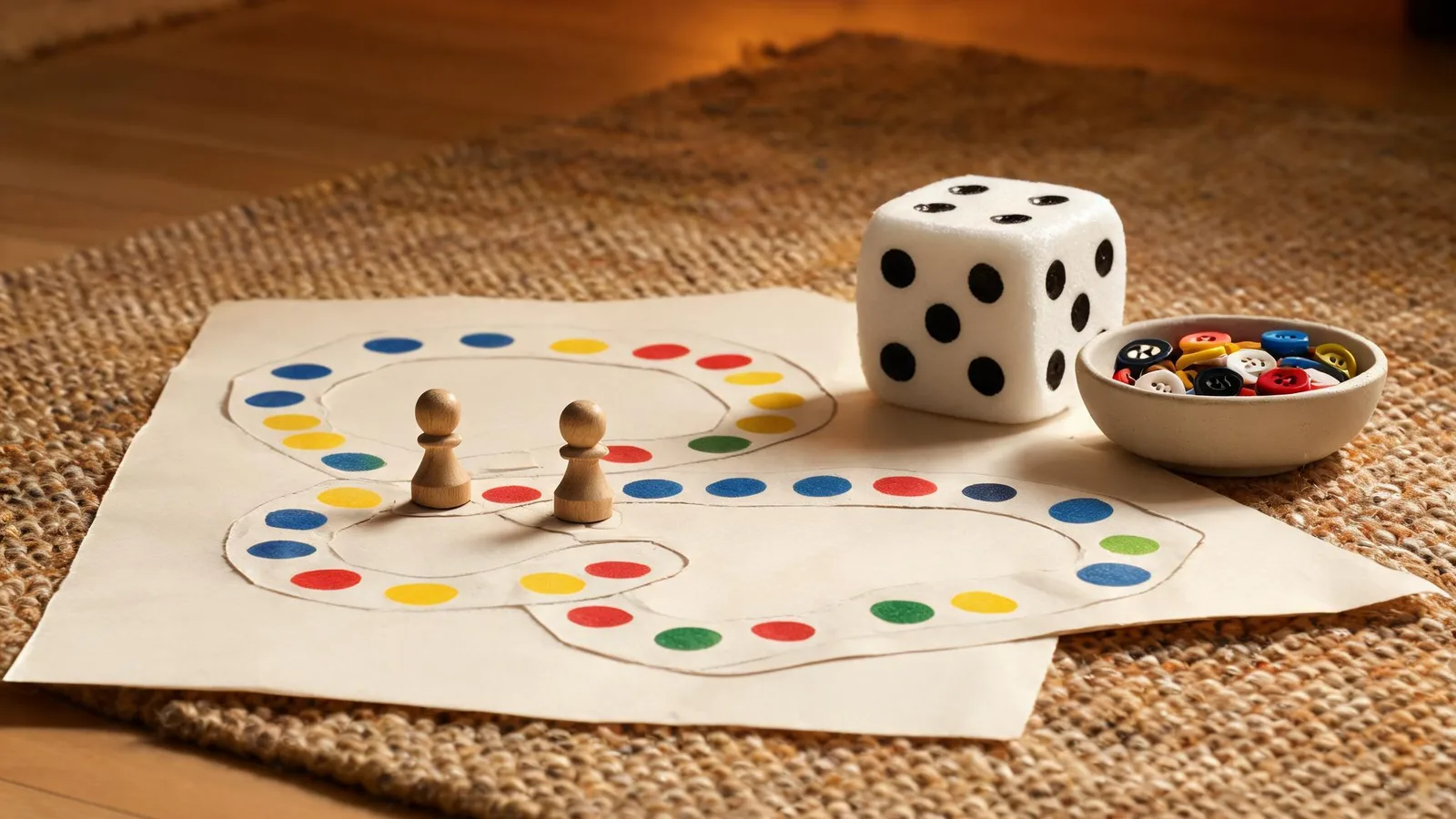
Games for preschool that one adult can play with one child, with no screen, are ordinary games with a one-line rule. Here is the set. The move each game asks for is in the last column: listen, wait, match, count, or move your body.
| Game | One-line rule | The move it asks for |
|---|---|---|
| Simon Says | Copy the action only when the cue words come first | Listen |
| Follow the Leader | Do what the leader does, then trade roles | Listen and move |
| Red light, green light | Go on green, freeze on red | Wait |
| Freeze dance | Dance while music plays; hold still when it stops | Wait |
| I Spy | Name a color or a shape; the other person finds it | Match |
| Memory | Turn two cards; keep the pair if they match | Match |
| Hide and seek | One person hides, or you hide a toy and give one clue | Move and listen |
| Sock toss | Toss a balled sock into a basket from a tape line | Move |
| Paper path | Roll or spin, move a sock that many spaces, do the square | Count |
| Tic-tac-toe | Three in a row on a drawn grid | Match |
| Color steps | Step only on the color that is called | Listen |
| Restaurant | You order; they "serve" from empty boxes and a drawn menu | Talk and pretend |
You do not need a website login for any row. NAEYC suggests turning off technology, including texts, calls, and television, while you spend time with your child. Put the phone in another room before the first round.
Screen-free games for one grownup and one child
Search results for preschool games often land on websites. This page stays in the room you are already in. One grownup is enough. You are the other player, the caller, and the person who ends the round.
The American Academy of Pediatrics describes Simon Says, Follow the Leader, tag, and a walk where you notice clouds, grass, or bugs. With one child, tag can be "tag the cushion": they try to touch a pillow before you do, then you trade. On a walk, I Spy uses a color, not a quiz score.
CDC names tag, follow the leader, and hide and seek as outdoor games, plus red light, green light and freeze dance as stop-and-wait games. Indoors, the hall is the track. Hide and seek can be hiding a shoe, with one clue such as "under" or "behind."
What games to play with small kids: start with the listen-and-move rows. What are good games for preschoolers is the same list, chosen for the mood. Wiggly child: sock toss or freeze dance. Quiet child: memory or I Spy. Child who wants to talk: restaurant.
Interactive, here, means you answer each other. They call a color, you step. You hide the toy, they hunt. A video that plays while you cook is not on this list.
One-line rules
Keep the rule to one sentence. If you need a second sentence, the game is too fiddly for today.
- Simon Says. You do an action. They copy only if you said the cue. If you forgot the cue and they copy anyway, smile and start again. No one has to be "out" when there are only two of you.
- Follow the Leader. Three actions, then they lead. AAP treats this as everyone copying the leader. At home, trading the lead is the whole game.
- Red light, green light. CDC suggests this when a child is excited and needs a stop-and-wait game. Green means walk or hop. Red means still. Add yellow as "slow" only after green and red are easy.
- Freeze dance. Music on, bodies move. Music off, bodies stop. You can hum if you do not want a speaker.
- I Spy. "I spy something blue." They point. Then they spy, and you point. Shapes work the same way.
- Sock toss. Tape a line. Basket on the floor. Toss. Move the line closer if every sock misses.
Educational games, in this house, are the rows whose move is count, match, or listen. Counting happens on the paper path and when you count hops. Matching happens in memory, I Spy, and tic-tac-toe. Listening happens in Simon Says and the color-step game. You do not pause afterward for a quiz.
Fun educational games to play on a tired day are the ones with no setup: Simon Says and I Spy. Save the paper path for when you can sit.
Homemade boards and card games
What board games do kids play, in a form you can make before dinner:
Path game. Draw a snake of squares on the back of a flyer. Some squares say hop, clap, or spin. A balled sock is the token. You can call a number from one to three so you do not need a die at all. Rule: move that many squares, do what the square says, other person's turn.
Memory. Two pairs for a younger child, more pairs later. Use playing cards, or paper squares with a dot of the same color on two of them. Rule: turn two, keep them if they match, turn them back if they do not.
Color match. Lay three paper plates or three scarves. Call a color. They touch it or put a sock on it.
Tic-tac-toe. Draw the grid. CDC lists tic-tac-toe and matching games as simple games to play. If they draw on the grid instead of marking X and O, keep the drawing.
Easy board games are the short path and the two-pair memory. A game that needs reading a paragraph of rules can wait.
Game tokens and beads can be a choking hazard if they fit entirely in the small-parts cylinder and the toy is meant for children younger than three, which the CPSC small-parts page spells out. Use a balled sock as the token so the marker is not a small piece. If a bead or another small token is out anyway, you stay at the table, because the CPSC toy safety publication says proper supervision of children at play is how to protect children from toy-related injuries.
When you want the path, the letters, and the counting cards already drawn, the Hands-On Kit Set: all 4 kits includes roll-and-move boards for counting, colors, shapes, and letters, plus letter-matching cards, counting cards, and shape cards. Those pages are print-only PDFs you print and cut. The set requires an adult who supervises play around small pieces. Household games above do not need the set.
More movement ideas that are not turn-taking games are on preschool activities at home. Counting beyond a path of squares is on preschool math activities. Hands jobs such as tearing and placing are on fine motor activities.
Games a three-year-old can finish
Good board games for a three-year-old are the ones that end quickly and do not require a winner.
- Memory with two pairs only. Play once. Shuffle if they ask.
- A path of a few squares. You may move the sock while they point to the next square.
- Color match with two colors, not six.
- Hide the toy, one hiding spot, one clue word.
- Sock toss from very close.
What games are appropriate for a small child is the same filter: one rule, your lap or the same rug, and an ending they can notice ("we found the bear"). If they walk away, the game is over. Do not restart to finish a round they left.
A three-year-old and a four-year-old in the same room can share freeze dance. Give the younger child fewer pairs in memory, and let the older child be the caller for one round of Simon Says.
Games a four-year-old can stretch
What games are appropriate for a four-year-old, and what board games four-year-olds often enjoy at the table:
- A longer path, still on one sheet of paper.
- Tic-tac-toe, even if the rules drift.
- Memory with three or four pairs.
- Red light, green light with hop and tiptoe added after the stop is reliable.
- Follow the Leader where they lead a longer string of actions.
- Restaurant with a drawn menu and you as a fussy customer who asks for "the blue soup."
CDC also suggests letting children play with other children at a park or library when that is available. At home, you are the other player. For preschoolers, and for the question about educational board games for kids in this age range, the path, memory, and tic-tac-toe are the table games; this page does not cover grade-school trivia. Educational games for four-year-olds on this page are the path (count), memory (match), and Simon Says (listen). Good educational board games for a four-year-old are the path and tic-tac-toe, not a boxed trivia game.
They may change a rule mid-round. Agree to the new rule for one turn, or say "we are using the old rule until this path ends." Either choice is fine. The catch with rule games: a child who must win every round will not be soothed by a better board. End while it is still a game.
Free play with no login
Free games for preschoolers, in the sense of no fee and no account, are the twelve rows at the top. Paper, socks, a ball, your voice. If you want cards you do not have to draw, the kit set is optional and separate.
A rainy afternoon of games (illustrative)
This sequence is an illustration, not a script you owe the afternoon.
Start with I Spy on the couch. Move to freeze dance in the hall. Sit for two-pair memory. If they are still there, draw a short path and play until someone reaches the end. Finish with restaurant while you heat food, using the pot you already need.
One limit of a game list: it cannot make a child stay. When they leave the table, the round is done, and that is a complete play session.
What are some fun games for preschoolers?
Simon Says, freeze dance, hide and seek, a sock toss, and a short memory game with two pairs of cards.
What are some good educational games for preschoolers?
Pick a game whose move is counting, matching, listening, or waiting. The move is the point; you do not add a quiz at the end.
What are some fun and homemade games I can play with my preschooler?
Draw a path on paper, toss socks into a basket, or hide a toy and give one clue. No box required.
What are some good board games for a 3-year-old?
A path of four or five squares, memory with two pairs, and a color match. You can move the piece if they would rather point.
What are some good board games for a 4-year-old?
A longer paper path, tic-tac-toe, and memory with more pairs. Let them change a rule if the game stalls.
What are some free games for preschoolers?
Every game on this page uses voice, paper, socks, or a ball. A login or a subscription is unnecessary.