
Math activities for preschool you can do at home today
Published 2026-10-16 · Updated 2026-10-16
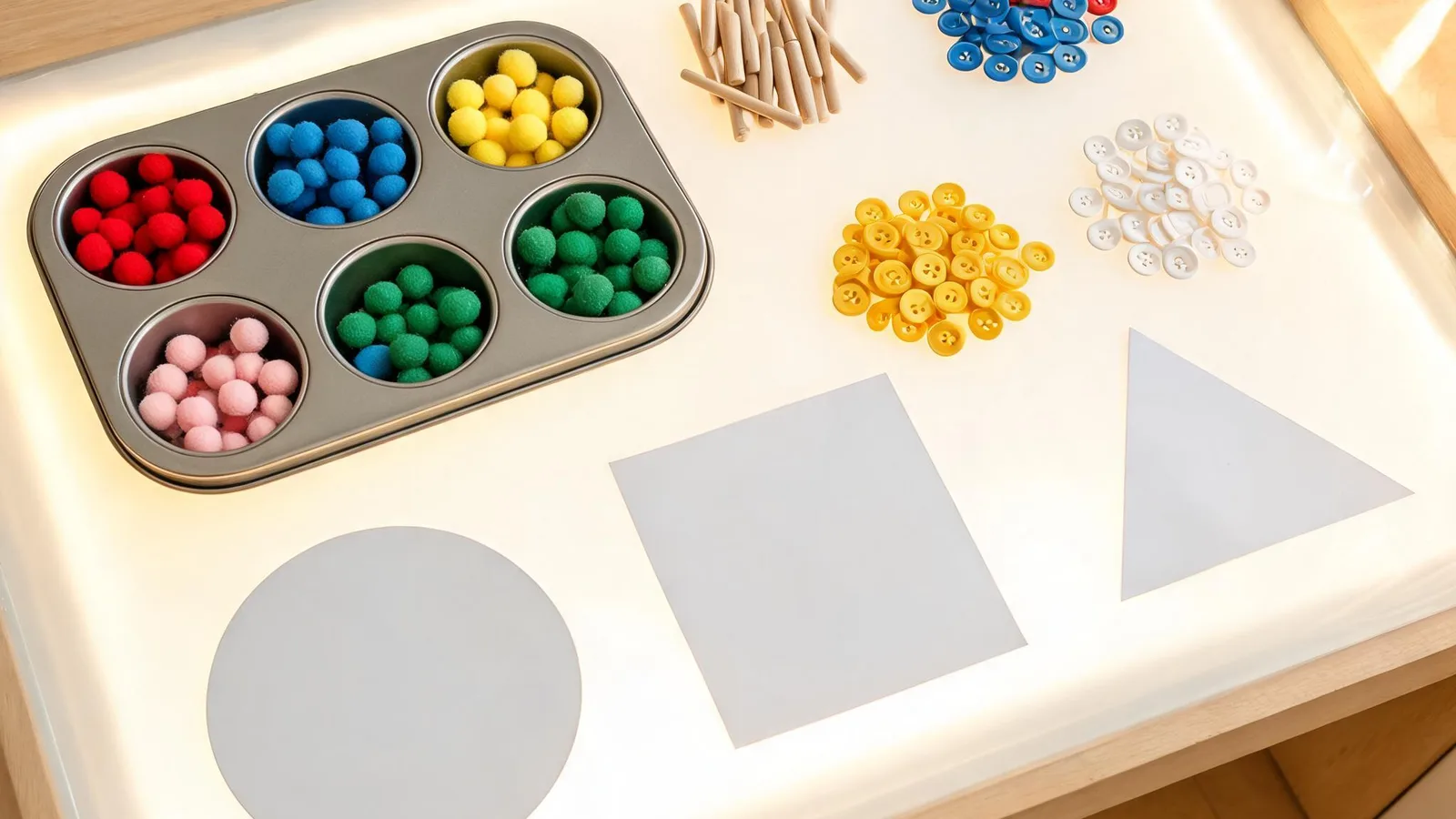
You can do these math activities for preschool at home with things already in the kitchen or the laundry basket. The short list is: count objects you can touch, match one item to each number you say, sort by color or type, hunt for circles, squares, and triangles, copy a short pattern, compare which pile has more, measure with hands or steps, and play a counting game that uses no screen. Details, an easier option, and the public checklists sit under that list.
The Illinois mathematics domain groups preschool benchmarks into sense of numbers, identification of relationships in objects, concepts of geometry, and analysis of data information. Zero to Three names a related set used in daily routines before school: understanding size, shape, and patterns; counting verbally; recognizing numerals; identifying more and less; and one-to-one correspondence, which means matching sets.
What to gather before you start
Lay out spoons, socks, blocks, a few lids, and paper. Keep coins away from infants and children, and keep other small household items out of the reach of infants and young children, as the American Academy of Pediatrics choking-prevention page says; that page says pieces of toys are among the objects that cause the most choking deaths, and that most children who die from choking are under age 5 (choking prevention). Large spoons and socks do the same counting job.
The CDC says developmental milestones are things most children (75% or more) can do by a certain age, and its lists are not a substitute for a screening tool (milestones by 5 years). Use the lists to see what public pages name. They are not a score for your child. That is the one honest limit of the games below: they are practice you can do today, not a verdict.
Counting and one-to-one matching
Illinois Early Learning writes that children ages 3-5 need a number name for anything they count, and that number names have a set order. The same tip sheet says to touch each object while you count aloud. That is the move to copy at the table.
Try these, in this order:
- You touch each spoon and say the number. Your child watches.
- Your child touches, you say the number.
- Your child touches and says the number. Stop when the words and the spoons stop matching, and go back one step.
Set the table the way the tip sheet suggests: one napkin and one cup per chair. That is one-to-one matching, with no worksheet. In a line or a waiting room, ask "How many trucks do you see?" as the waiting-time math sheet does, and put one can on top of each cereal box so each item gets one number.
Easier option: count only the spoons you can hold in one hand, and you say every number. Harder option: count the spoons, cover two, and ask how many are still on the table. You can answer together.
The CDC five-year checklist includes "Counts to 10" and "Names some numbers between 1 and 5 when you point to them" (milestones by 5 years). Those lines are not on the four-year checklist, which does name a few colors of items, and they are not on the three-year checklist, which includes stringing items together, like large beads or macaroni, and drawing a circle when you show how. A three-year-old can still count spoons with you. A four-year-old can sort by the colors the four-year list names, and can hold a crayon between fingers and thumb rather than in a fist, which helps when you draw a number later.
Parents ask whether a four-year-old should already do simple math. The public pages do not set that as a pass mark. Offer the spoon count and the napkin match. If your child wants to stop, stop. More wider play for a four-year-old sit beside this if you want a wider afternoon, and play for a three-year-old if the spoon pile is still too long.
Screen-free counting games
These games use one adult and one child. No app, no video. The five-year CDC checklist includes paying attention for 5 to 10 minutes during activities such as story time or making arts and crafts, and the example sets screen time aside (milestones by 5 years). A younger child may leave sooner. Let them.
Sock pile. Dump clean socks. Touch each sock once and count. Easier: count only the socks that are one color. This is a counting game, not a race.
Spoon cups. Say a small number. Your child puts that many spoons in a cup. Easier: you put a spoon in for each word, and your child says "more" or "stop."
Stair or path count. Count steps to the door, the way the waiting-time sheet asks "How many steps to the car?" Easier: count only to three, then walk the rest in silence.
Two piles. Make one pile of blocks and one of spoons. Ask which has more, starting with piles that look very different, as the beginning-numbers sheet suggests when it compares a large group with a small one. Easier: you point to the bigger pile and your child nods or shakes their head.
Laundry sort, then count. Sort socks from shirts, then count one pile. Sorting by a property is the move in Illinois's sorting sheet: socks, shirts, and pants during laundry, or spoons and forks when the dishes are dry. Easier: you sort, your child drops the next sock on the sock pile.
A regular deck of playing cards can stand in for numeral cards. Flip one card, say the numeral, and place that many blocks beside it. Face cards can mean "skip." If you want cards already printed for count-and-clip, numeral, and ten-frame play, that set is linked after the shape section. More screen-free ideas that are not only math live in games for preschoolers.
Shape activities
Illinois's shape sheet says to talk about circles, squares, and triangles, and about balls, cubes, and cones. It also says a can has a round flat circle on top, while the whole shape is a cylinder. Use those words on a walk through the kitchen.
Shape activities that stay at the table:
- Shape hunt. Find one circle (a plate), one square (a cracker or a window pane), and one triangle (a folded napkin or a roof you draw). Say side, curve, and inside, which the sheet lists as useful words.
- Lid tracing. Your child holds a crayon between fingers and thumb if they can, and traces a lid. The four-year checklist includes that grip. Easier: you hold the lid and they scribble inside the circle.
- Block talk. Name the block as you add it: cube, cylinder, or a square side. The geometry tip sheet suggests describing objects by shape while children build.
- Hand shapes. Ask if two hands can make a triangle, which that geometry sheet invites. Easier: you make the shape and they copy with their arms.
- Paper shape craft. Draw one big circle. Your child tears scrap paper and glues pieces inside the line. This is a home craft, not a published lesson. Easier: you tear, they press the glue stick.
Parents also ask whether a four-year-old should know shapes. The four-year CDC checklist names a few colors, not a shape list. Illinois treats shape talk as preschool math for ages 3-5, including hunting squares, triangles, rectangles, and circles while you wait. Offer the hunt. Do not treat a missed triangle as a problem to fix in one afternoon.
Hand work with paper and lids is in fine motor activities for preschool.
Patterns, sorting, and a tiny graph
A pattern is a repeat your child can continue. Start with two things: sock, spoon, sock, spoon. Ask what comes next. Easier: you point to the next spot and they place the object you name.
Sorting is the data piece a preschooler can actually do. Two bowls, one rule: red in this bowl, not red in that bowl. Then change the rule to big and small. The sorting sheet also uses food at a meal: corn and bell pepper can both be yellow, and you can ask whether the carrot is yellow or a different color.
A tiny graph: two snack choices, one sticker or tally mark for the choice your child picks today. Count the marks tomorrow and ask which column is taller. Illinois describes classroom voting and graphs in the beginning-numbers sheet. At home, two days of snack marks is enough.
Measurement, from the waiting-time sheet: "How many hands tall is this jar?" and "Which is heavier, your coat or your boot?" Guess first, then check. Easier: you do the hands, they say "taller" or "shorter."
A kitchen afternoon (illustrative)
This afternoon is illustrative, not a log from a real family. Times are made up so you can see the order.
| Block | What you do | Easier option |
|---|---|---|
| First | Count five spoons, touching each one | You count, child taps the spoon |
| Next | Shape hunt: plate, window, folded napkin | Only look for circles |
| Then | Sock, spoon, sock, spoon pattern | You place every other item |
| Last | Two snack stickers on a paper | You draw the marks |
Stop when the child leaves the table. The point of the sample is the order, not the minutes.
When printed counting cards help
The games above need no purchase. If you want pages that are already a count-and-clip card, a numeral card, and a ten-frame card, use Counting Cards 1 to 20 to print, cut and play counting games with a 3 to 5 year old. The How to Play guide has three games, each with an easier option. You print the pages yourself; nothing arrives in the mail. Small pieces mean an adult supervises play.
A reader who never buys that set still has the spoon count, the shape hunt, and the sock pattern. Pair this page with preschool activities at home when you want the rest of the day, not only math.
What is a typical math skill for a preschooler?
Illinois groups preschool math as number sense, relationships among objects, geometry, and looking at data. Zero to Three also names counting, shapes, patterns, more and less, and matching one item to one number.
How do you teach math to preschoolers?
Count real objects while you touch each one, then sort, compare two piles, and name shapes you can see. Keep the sitting part short and offer an easier version if your child walks away.
What are some math activities for preschoolers?
Count spoons, set one napkin per chair, sort laundry, hunt circles and squares, copy a two-color pattern, and measure a jar with hands.
What to teach preschoolers about shapes?
Name circles, squares, and triangles, and also balls, cubes, and cans. Talk about side, curve, and inside while you hunt or build.
What numbers should a preschooler know?
The CDC five-year checklist includes counting to 10 and naming some numbers between 1 and 5 when you point to them. That checklist is what most children do, not a pass mark for one child.
How to help kids with math at home?
Use waiting time and chores: count trucks, sort socks, and ask which pile has more. You do not need a workbook to start.