
How to homeschool kindergarten: subjects, supplies and state rules
Published 2026-10-23 · Updated 2026-10-23
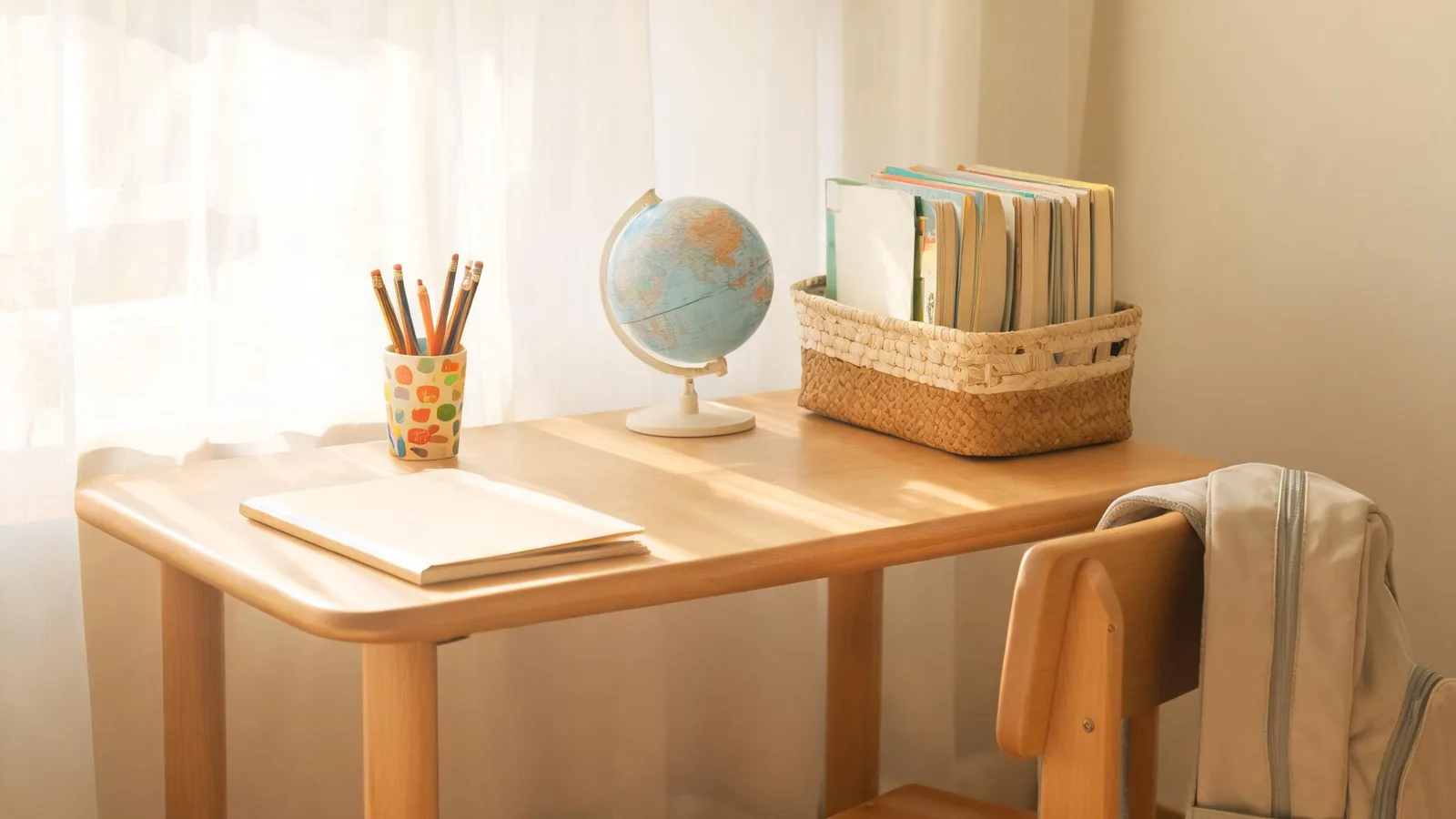
Subjects for a home kindergarten week
To homeschool kindergarten, pick a short menu and a short sitting, then read your state's education-department page before you file anything. A practical home menu looks like this:
- Spoken sounds, then letters. Say rhymes and stretch the sounds in a short word before you ask for reading. The IES practice guide for kindergarten through 3rd grade recommends developing awareness of the segments of sounds in speech and how they link to letters. Home versions of the spoken games are on the phonemic awareness activities page.
- Counting and comparing with objects. Buttons, spoons, stairs. The kindergarten counting standards say to count to 100 by ones and by tens, to write numbers from 0 to 20, and to count as many as 20 things in a line. Some public programs use those standards. Your state may use another list. Card and die versions are on kindergarten math games.
- Adding and taking away with the same objects. Put two small groups together. Take a few away. Keep the piles small enough to count on fingers.
- A read-aloud. You read. Your child talks about the picture. A library card covers this.
- Something real. A plant on the windowsill, a walk to the mailbox, a drawing of the kitchen. That is the science and social-studies slice for a home week: look, name, draw.
- Hands. Drawing and tearing paper.
That menu answers the cluster of questions about what to teach a homeschooled kindergartener, what subjects belong in a kindergarten homeschool, and what good topics look like at home. It is a menu you can shrink.
Supplies from the kitchen drawer
A workable pile:
- Paper and a pencil
- Crayons or one pencil in a dark color
- A deck of cards with face cards set aside, or a die, for counting
- A handful of buttons, blocks or crackers
- Books from the library
- A glue stick if you want collage
A printer helps when you want a page to write on. The floor works.
People ask what a kindergartener should be learning, and what a five-year-old should know by the end of kindergarten, and what a five-year-old should know academically. The counting standards above name topics some public programs use. A home checklist, if you keep one, can record what you practiced.
State rules differ
Homeschool rules are written by states, and the pages differ. Read the education department for the state where you live. Two captured examples show why a national checklist would be the wrong tool.
The Texas Education Agency lists regulating, indexing, monitoring, approving, registering, and accrediting home-school programs as outside its role. The same page says home schooling has been a legal alternative to public schooling since 1994, and that parents who choose to home school are required to follow a course of study that includes good citizenship. A district may request a letter of assurance that the student is being home schooled. That is Texas, as TEA describes it.
Washington OSPI says Washington state law recognizes the desire of some parents and families to seek home-based instruction. It says each person whose child is receiving home-based instruction must file annually a signed declaration of intent. The declaration is filed by September 15 of the school year, or within two weeks of the beginning of a public-school term, with the district superintendent where the parent resides. Washington's declaration is a different step from the Texas page.
Those two official pages describe different processes. Yours may be a third version. Open your state education department's home-school or home-education page and follow that page. This page is not legal advice.
Parents ask whether they can homeschool a five-year-old for kindergarten. The National Center for Education Statistics counts homeschooled students ages 5 to 17 with a grade equivalent of kindergarten through grade 12, and its survey rule for that count keeps public or private school enrollment at or under 24 hours a week, among other survey rules. That is a survey definition, not a permit. Compulsory-attendance ages and kindergarten rules are state matters. TEA and OSPI are examples of where a state puts its explanation. Your state page is the one that applies to you.
An illustrative first week
Shrink it. Swap the walk for the plant. Repeat Monday if that was the sitting that worked.
| Day | Sitting | You can drop |
|---|---|---|
| Monday | Read a picture book, then count the spoons in the drawer | The writing of numerals |
| Tuesday | Spoken rhyme and one slow blend of a short word | Any letter cards |
| Wednesday | Two piles of buttons, which has more | The die |
| Thursday | Walk outside and name five things you see, then draw one | The drawing, if the walk was enough |
| Friday | A snack story: some crackers on a plate, a few eaten, count what is left | Anything written |
A minute-by-minute day plan is a different job. The kindergarten homeschool schedule page is the place for shaping the day. This page is the start: subjects, supplies, the state pointer, and one week you can change.
Hard parts
Is it a good idea? Families choose it for their own reasons. NCES reports parent reasons in its homeschooling fast facts, including concern about the school environment. You know your child, your job, and your state.
Is it hard? The hard part at kindergarten age is usually the planning. A short sitting that you can repeat beats a long morning that collapses. You are allowed to stop when the child is done. You are allowed to do the same game again tomorrow.
Letter sounds, if you want a slower start than CVC words, are walked through for a younger child on how to teach the alphabet to preschoolers. The moves transfer. The age on that page is younger than kindergarten.
A year file if you want the map
When the menu is clear and you want the days on paper, use Home Preschool Year: Kindergarten, ages 5 to 6. It has a Year Map of all 36 weeks and 180 numbered lessons, undated, with the answers kept off the child's pages. It is not aligned to or approved by any state or school program for this download.
Look at one week in the week file sample before you decide.
What should I teach my kindergarten at home?
A practical home menu is spoken sounds, counting with objects, a read-aloud, a look at something real, and drawing.
What do I need to homeschool a kindergartener?
Paper, a pencil, crayons, a few household objects, and the education-department page for your state. The kitchen table is enough.
What subjects should be taught in kindergarten homeschool?
Many families cover early reading, math, and a bit of the world around them. Your state page says what you must file.
Is it a good idea to homeschool in kindergarten?
Families do homeschool kindergarten-age children. Whether it fits your child and your state is yours to decide.
Is it hard to homeschool a kindergartener?
The hard part is choosing a short sitting and stopping.
What is a typical kindergarten curriculum?
States differ. Some public programs use the Common Core counting standards. Your state may use something else.