
Kindergarten math games with cards, dice and paper
Published 2026-10-16 · Updated 2026-10-16
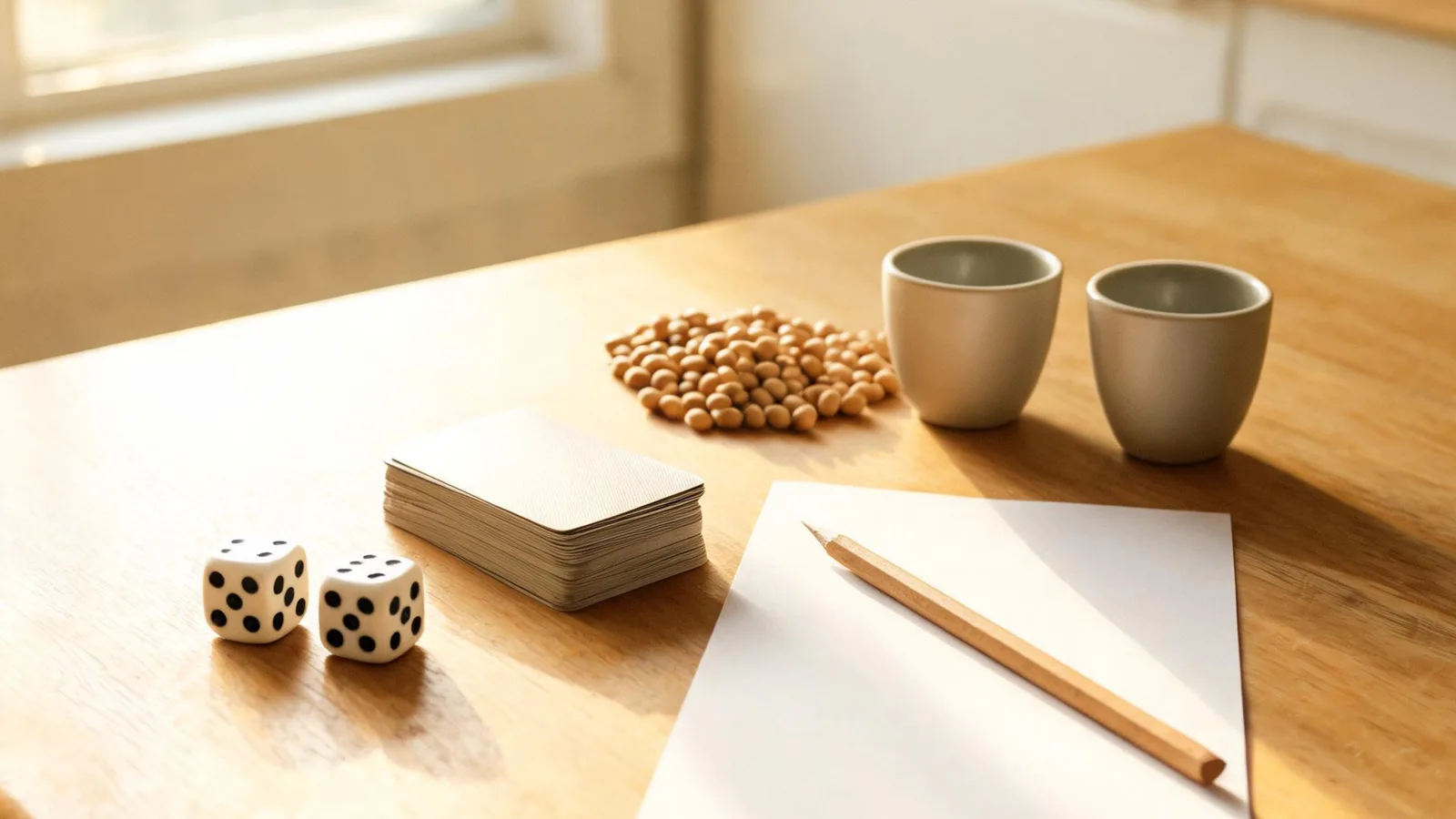
Games you can play with a deck, two dice and scrap paper
You can play kindergarten math games tonight with a deck of cards, one or two dice, and a pencil. Leave face cards in the box. Ace can stand for one. These seven games stay with counting, comparing, and adding or taking away. The kindergarten operations standards say to add and subtract within 10, for example by using objects or drawings.
- Flip and count. Turn one card from ace through ten. Your child touches one button, block or cracker for each count, then says the last number for the whole pile.
- Two-pile match. Deal two tiny piles. Match one object from the left pile to one from the right. Say which side has more, which has fewer, or that they match.
- One-die hop. Draw a path and write the number words one through ten under the spaces, or write numerals if your child already reads them. Roll one die. A finger hops that many spaces.
- Make-ten pairs. Lay out cards from ace through nine. Find two cards that go together to make ten. The operations cluster says that for any number from 1 to 9, the child finds the number that makes 10, using objects or drawings.
- Cup take-away. Put a small pile in a cup. Tip some out. Count what spilled and what stayed in the cup.
- Cover and guess. Line up a few counters. Cover some with your hand. Your child says how many are hiding, then you lift the hand and count together.
- Cracker story. Tell a two-line story and act it with real crackers: some on the plate, a few more arrive, or some get eaten. Fingers, claps or a quick drawing can stand in for the crackers.
A reader who never buys a packet still has the whole set. The honest limit is that a game list does not choose Thursday's game for you. You still pick one and stop when attention fades.
Counting before you add
NCTM's early childhood statement says that long before entering school, children spontaneously explore and use mathematics in play and daily activities. A kindergarten game can stay inside that kind of play: spoons, stairs, socks, a walk to the mailbox.
The counting standards name a wider menu than one evening of cards. They say to count to 100 by ones and by tens, to write numbers from 0 to 20, and to count to answer how many about as many as 20 things arranged in a line. Scattered objects are named more tightly: as many as 10 things in a scattered configuration. Comparing two written numerals is described for numbers between 1 and 10.
You do not have to play all of that in one sitting. A useful split:
- Line count. Set crackers in a row. Your child says one number name per cracker. The last name told is the size of the row.
- Scatter count. After a line feels steady, shake the same crackers into a loose pile and count again. Stay at ten things or fewer so you are inside the scattered-object line in those standards.
- Numeral beside the pile. You write the numeral, or your child writes it, next to the pile. The writing standard runs from 0 to 20. A home game can live inside ten and still sit next to that wider writing range.
- Forward from a number that is not one. Pick a card, say that number, and count on a few more names. The counting standards include counting forward from a given number inside the known sequence, instead of always starting at one.
If the count wobbles, you count and your child points. That is an easier option, not a failed lesson.
Younger siblings can use the same objects with a shorter pile. The preschool math activities page is written for that younger sitting. Kindergarten games on this page keep the within-10 adding and taking away that the operations standards name.
Adding with cards and objects
Addition, in the home version of these standards, is putting together or adding to. The operations page says to represent that with objects, fingers, mental images, drawings, sounds such as claps, acting out, verbal explanations, expressions or equations.
Try this order. Stay on a step as long as you like.
- Two piles meet. "These three crackers and those two crackers go on one plate." Count the plate. Use words while you talk. The standards' own pair example is written with digits: 5 = 2 + 3 and 5 = 4 + 1. You can show that pair with crackers before anyone writes it.
- Fingers. One hand shows the first group. The other hand shows what got added. Count all the fingers.
- Dots on scrap paper. Draw a dot for each object, then circle the whole set.
- A die only when you want a random group. One die stays at six or under. Two dice can pass ten, so agree that a roll past ten is a reroll if you are keeping the game inside the within-10 line.
- Cards the same way. Turn two cards only when both are small enough that the sum stays within ten. If a pair would pass ten, put one card back and turn another.
A "lesson" here is one of those steps plus the cleanup. Parents who ask for examples of math lessons can rotate flip-and-count, a make-ten pair hunt, and one cracker story across three sittings. Parents who ask for good math lessons can use the same rotation. Nothing on this page is a graded worksheet.
Taking away with a cup
Subtraction, on that same operations page, is taking apart and taking from. The cup game is the home version.
- Start with a pile your child can count.
- Remove some into the cup, under a napkin, or into a mouth if they are crackers.
- Count what is still visible.
- Lift the cover and count the hidden part so both parts are seen.
Fun subtraction activities for a kindergartener are mostly this move with a new object: buttons off a plate, blocks off a tower, chairs pushed back from a table of toy guests. Simple subtraction games do not need a board. Cover-and-guess is the game. Cup take-away is the game. Eating two crackers from a counted plate is the game, if you are actually having a snack.
If you want a written equation, write it after the objects have already told the story. The standards allow an equation. They also allow claps and a verbal explanation, so a child who will not write yet can still play.
An illustrative card week
The week below is illustrative. Change the object, skip a day, or repeat Monday if that game was the one your child asked for again.
| Day | Game | Easier option |
|---|---|---|
| Monday | Flip and count with crackers | You say the number names; your child touches |
| Tuesday | Two-pile match with socks | Use only three socks per pile |
| Wednesday | Make-ten pairs with cards | You name one card; your child finds the partner |
| Thursday | Cup take-away with blocks | Remove only one block |
| Friday | Cracker story, then one-die hop | Skip the die and hop a chosen small number |
Standards these games sit beside
People ask what a kindergartener should be able to do in math, and what a five-year-old should do. This page will not turn a standard into a verdict on your child. The counting standards describe counting to 100 by ones and by tens, writing numbers from 0 to 20, counting as many as 20 things in a line, and comparing numerals between 1 and 10. The operations standards describe adding and subtracting within 10, breaking numbers less than or equal to 10 into pairs, and finding the partner that makes 10 for any number from 1 to 9.
A game practices a slice of that menu. It does not report a school-readiness result. If a public kindergarten near you uses a different state list, read that list too. These Common Core pages are a clear public description, not a law for every state.
Counting games for kindergarteners, if you want them named again in one place: flip and count, stair counting, scatter counting, and writing a numeral beside a pile. Addition games: piles that meet, finger adding, dot drawings, small card pairs. Subtraction games: cup, napkin cover, and a snack story.
Easy addition activities are the first two of those, with you counting aloud. Easy ways to teach addition are the same moves, slowed down, with fewer objects. Fun ways to learn subtraction are the cover games, because the hidden part is the interesting part.
If you want the days already written
When the card games are working and you want reading and math already paired on a page, Home Preschool Year: Kindergarten, ages 5 to 6 is a year of week files: a week guide with reading, math and science or social studies steps for Day 1 to Day 5, a print-and-gather list, and 8 activity pages. It is print-only PDFs; nothing is shipped. It is not aligned to or approved by any state or school program.
A week file sample shows the shape of one week. Spoken sound games you can play with your voice alone are on the phonemic awareness activities page. Preschoolers who are not ready for within-10 adding can stay with games for preschoolers.
What are some good math activities for kindergarteners?
Flip cards and count objects, compare two piles, roll one die onto a paper path, and act out a take-away story with crackers.
What are some fun math games for kindergarteners?
Use a deck for make-ten pairs, one die for a paper hop, and a cup of counters for taking some away.
How do I teach my kindergartener math?
Sit beside your child, use objects or fingers for a tiny story, and stop while the game still feels like play.
How to teach addition to a kindergartener?
Put two small groups together, count the whole group, and only later write a sentence such as the standards' pair example.
How to teach subtraction to kindergarten kids?
Start with a known pile, remove some, and count what is left. A cup or a napkin works as the cover.
What are some fun math activities for 5-year-olds?
The same card, die and paper games fit a five-year-old at the table. Keep the piles small and let the child move the pieces.